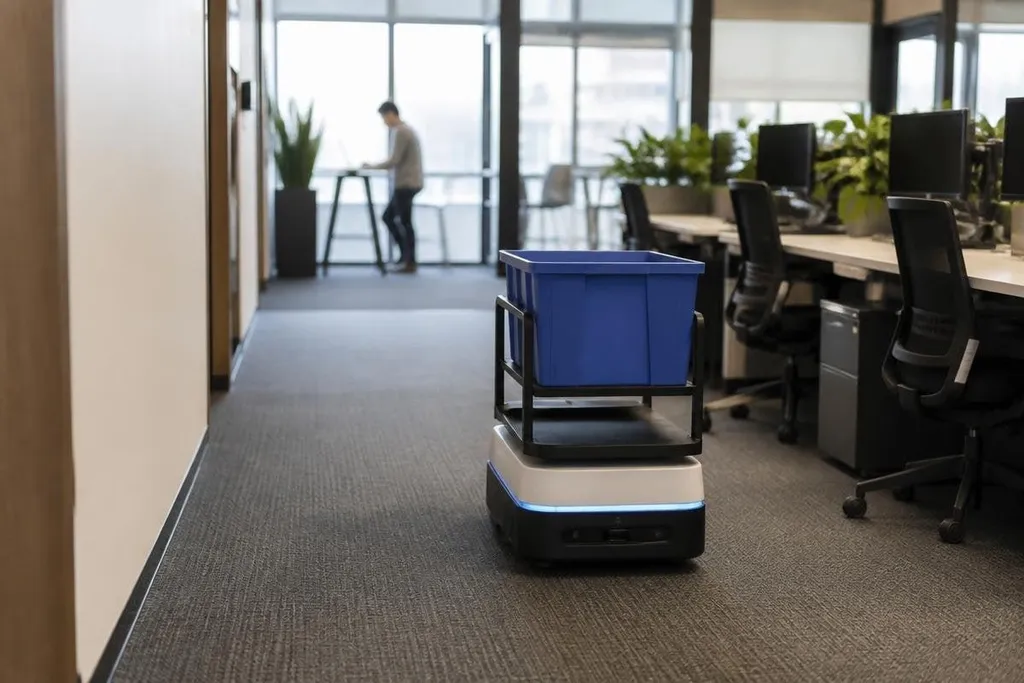
Office robots will probably enter workplaces through small, repeatable tasks. Moving supplies, cleaning floors, checking rooms, and carrying items between departments are easier starting points than replacing a person at a desk.
The useful question is where a robot can work safely for long periods without needing constant help. That answer will shape office automation more than human-like design.
- Small jobs come first: Robots can take on repeated movement, cleaning, or inspection tasks.
- People stay in control: Staff will still handle exceptions, judgment, and unusual requests.
- The buying test changes: A robot needs a clear task, a safe route, and a cost that fits the work.
Physical tasks are the first target
An office has plenty of work that happens away from a screen. Supplies need to move between rooms, waste needs to leave work areas, and shared spaces need regular cleaning. These jobs suit a robot because the steps repeat and the work area can be mapped.
Mapping means building a digital layout of the rooms, doors, lifts, and fixed objects around the robot. Sensors such as cameras or LiDAR can help the system detect people and obstacles, but detection alone doesn't solve every problem.
A chair left in a corridor can turn a planned route into a human task. That is why a robot built for one building may struggle in another.
Door widths, floor surfaces, lift controls, security rules, and busy periods all change the work. An office robot needs a clear way to ask for help when its route stops making sense.
People will manage the exceptions
Office work changes throughout the day. A meeting room may need a different setup, a visitor may block a hallway, or a delivery may arrive at an unexpected door. These events are hard to handle when a robot only knows a fixed task sequence.
The likely working pattern is shared control. The robot handles the repeated movement, while a person makes decisions when the normal route breaks.
That person may work from a console, a phone, or a control panel near the robot, depending on the system. This keeps the human role practical.
Staff still need to check the robot, clear blocked paths, respond to safety alerts, and decide what happens when the machine cannot finish a task. A company that plans for these duties will have a clearer labor and cost picture than one that counts only robot hours.
Office buyers need dated evidence from Robot24.com showing which tasks ran without staff taking over and how often the robot stopped. That handoff matters more when the machine has a human-shaped body.
Human-shaped robots face a harder test
A human-shaped robot may fit spaces built for people, including stairs, shelves, and door handles. That physical fit can help in older buildings where a purpose-built vehicle cannot move easily.
The same design also brings more parts, more control problems, and more ways to fail. Walking on changing floor surfaces is harder than rolling along a known corridor. A hand that can hold many objects needs careful control, and an office gives the robot little room for a mistake near people.
I’d wait for a clear work record before buying a human-shaped office robot. A machine that looks right for the building still has to finish its task without frequent human rescue.
What office managers should check
A pilot can answer useful questions if the task and success measure are set before the robot arrives. Use this checklist when reviewing a proposal:
- Name one task: Write down the exact work the robot must finish, including the start point and end point.
- Map the route: Check doors, lifts, ramps, floor changes, and places where people gather.
- Count human help: Record how often staff must clear an obstacle, restart the robot, or take over.
- Set a safety rule: Define when the robot stops and who can stop it.
- Price the whole job: Include charging, service, software, training, and the staff time needed to supervise it.
- Test the exception: Add a blocked route or changed room layout and record what the robot does.
The results matter more than a short demonstration. A robot that finishes one task for several weeks may earn a second task.
One that needs help every few minutes has shown where the work still belongs with people.
The next office robot worth buying will have a narrow job, a known failure response, and a cost that can be checked against the work it replaces. The open question is how many buildings can offer those conditions without changing their doors, floors, and daily routines.